Showing posts with label Gnosis. Show all posts

22 April 2013

The Breadboard

JM reiterates that we humans are here to learn…continuously. Anybody who ruminates a lot like me can agree that this is actually what we do … consciously or unconsciously and continuously: when we talk, when we listen, when we observe and when we act.

All experiences, good and bad, are learning experiences. Yes, there are opportunities to learn something even with traumatic experiences such as accident, physical injuries etc. and relatively minor experiences such as fall-from-grace, humiliation, divorce, disgrace etc. In fact everything is a learning experience. Even all (apparent) hindrances to one’s progress are actually opportunities to evaluate-learn-innovate-improve.

Is our innate goal to know it all and reach perfection? 


Consider the above illustration:  Brain as a platform for building information connects which in turn generates knowledge which in turn allows for ‘wisdom’. Like a breadboard where connections between points are made, connections like these together form a circuit to perform a larger function. Consider the neurons in the brain to be like these connection points waiting to be connected to another. A fresh (newborn) brain is blank and without any links….blank, happy, innocent and blissful.

A link between a few neurons may be formed when the baby learns that a smile gives (mother’s) attention in return.

Links are thereafter continuously formed and reorganized in different patterns over these infant years. Even a fall during its first steps also links connections, as this too is learning.

Later on in life, reading a book builds a few hundred connections (words, ideas, grammar, writing styles etc.)

Playing the piano builds another bus of connections in another area within the gooey matter.

Pursuing a hobby builds a few hundred.

Focusing on one area (say in one’s career) could organize the related connections from what looked like chaos at first to a pattern over the years of accumulation.

One may just not really know it all but may reach the threshold of completeness. It would seem there is infinite storage and infinite more stuffs to be learnt. But there could be peace at the stage when there is a pattern in the connections say like the image on the right.

End of Curiosity?

One of the yearnings (instincts I would say but not as basic as hunger) in human beings is “to know”. Curiosity is generally inherent in higher-brained animals but, I observe, that this itch unbearable for humans. It is as if to learn is the destiny of humans. What kicked-off as simple observation, in early humans, of patterns of danger and of the awe that is the sun, moon and stars is still in progress albeit to a very complex (or rather progressed) level. We now observe the most distant stars and the inner most particles; and also try to analyze consumer patterns which are as complex as the weather. Will this curiosity ever be satiated?


Is this state what is enlightenment (since I don’t know of another better word)?
As per Hinduism, one path to this state is Jnana yoga or the Path of Wisdom. Instinctively urged to follow this path one assimilates as much understanding as he can about the universe. Either through one source or varied, though the Hindu scriptures claim that understanding the Vedas would suffice.

 
My gatherings is that enlightenment is like the total understanding (maybe just acceptance) of everything’s place in the universe. The enlightened ones generally seem to be in a state of total calm. They also then tend to be extremely quiet and unfazed by events around then. They do not want to change anything. It is probably because they now feel everything in the universe is in its place and everything is right. Their quench for knowledge (of everything) satiated.

But enlightenment seems like conquering infinity by just understanding the finite?

Well I understand that at the point of the so-called enlightenment our brains are COMPLETE with all (necessary) findings…at least as much that a human mind/brain can process. It may not exactly be complete with everything in the universe but at least the basic patterns of the universe that explains everything i.e. the underlying basic rhythms of the universe or most fundamental equations in the universe.
Physically speaking this may indicate a brain complete with: all possible electrical connections it can achieve; all patterns it could humanly recognize.

8 March 2012

iBelieve...

... in the Singularity: the Infinite; the completeness of all worlds; the reason for all things visible, invisible and virtual;


And in Ruha, which is nothing but the will of Singularity: the omnipresent finger, the ordering principle in the ostensive chaos;


And in Matter, which is but just one of the human-sensitive manifestation of Singularity itself;


And in all the perceptive Beings, who for us humans guide us in this world and the next, in this life and the next higher life;


And in the catholic belief that through continuous learning, positive faith, discipline of action and enablement of other beings one will traverse the human-journey towards the Infinite with contentment and fulfilment


And in the recursion of updating this very creed if my wisdom deems so.


Amen.

28 May 2010

Karmic Credits

This post is not mine. I liked the analogy so much that for once thought I will just do a 'share' on my blog. All credits to the original author of this write-up. Man, you did then what the film Matrix did to the many of us!

"Hinduism is so complex. I do not understand it most of the time", said Eesha, a young girl to Uncle Ashok. Ashok had come over half an hour ago and Eesha was so engrossed in her video game then that she mechanically said "Hi" to Ashok, and continued with her game.
 
 
Ashok watched Eesha play Super Mario Brothers. He watched her move Mario to the right, hit and get hidden mushrooms and get bigger, or get a fire flower or a cape, collect coins, punch his way thru obstacles, climb ladders and occasionally get chomped by turtles. After the end of a life Mario would start his next life, from where he left off. Now that Eesha had finished one level she noticed that uncle Ashok, whom she met every week when her parents took her to the temple, was still there.

"Eesha, you are really good at this video game!” said Ashok. She nodded and added "Yep! And I can even beat my brother at it".
"You know you can learn many ideas of Hinduism from the video games", said Ashok.
"How Uncle Ashok?" Eesha asked.

Let us say if you got a video game and it gave you only one chance to beat it, will that be fair?” Ashok asked.
"No, that is why they give you multiple lives. Actually, with a new game it is very difficult to advance much further. It takes practice. When we had just bought this game, I used to 'die' in just ten seconds, every time", said Eesha.
"Hinduism is similar too. Most people do not lead a perfect life. So according to Hinduism, you get many chances to improve yourself. You get many lives. This is called reincarnation". He continued," and just as in a video game, if one life ends, you start over in the next life where you left off".

"Now what will happen if you do not go towards the right in your video game?" asked uncle Ashok.
"You will not move to the next level. You will not make any progress and time will run out", Eesha said
"Exactly! If you do not move in the 'right' direction, you will not make progress. Thus YOU determine the right direction and how far the progress you can make. 'What you do, determines the result' this is called the law of Karma. Your actions bear fruit accordingly. Now what happens in a video game if you keep making same mistakes?” Ashok asked.
"You go back to the start of that level" Eesha replied.
"Law of Karma similarly tells you that if you keep making same mistakes over and over again, you will move backwards. Now in a video game you get rewards and receive setbacks. In this video game a mushroom will make you grow bigger or an attack of a turtle will make you smaller, in real life too you may become rich or poor, but that depends where you start at and what actions you take. Yet getting big or small in itself does not mean progress. Does it?", asked Uncle Ashok.
"You are right, being big or small does not necessarily mean you will move forward in the game or even to the next level", Eesha replied.

"Now tell me what happens when you go to the next level?" Ashok asked.
"It gets tougher at the next level" Eesha said.
"Same is true in spiritual practice as per Hinduism", Ashok added. "Now tell me what happens if you get stuck at a level, what do you do ? and why ?", he asked.
"I ask my cousin Ojas. He knows what I should do. He knows where to the keys are hidden, where secret passages are. He has beaten the game already, Some times he even takes the controller to help me", Eesha said.
"In Hinduism, similarly a Guru helps you move to next level. A Guru or a master has already 'beaten the game'. She or He knows where the key is hidden that will unlock the door. She or He knows what where the secret passages are. She or He can even show you a 'warp' zone, to go to the next level. But unlike a video game, in real life a Guru cannot play for you. You have to play it yourself", said Ashok.
"You keep referring to Guru as She or He, why?” Eesha asked.
"Good question! Hinduism considers man and woman as having equal potential to become a master, a Guru. Just as you are better than your brother at video games, a woman can reach the highest state also. In fact there were many women who contributed to the Vedas, the Hindu holy books. There were many women Hindu saints in the past, and there are many women saints even now" said uncle Ashok. He continued, " alsothere are many ways you can go to next level, so some Guru will show a easier way and some a harder way, all depending on your capability.
Buddhists have Buddha as a Guru; Jains have twenty four Tirthankars as Gurus while Sikhs have ten Gurus whose guidance they follow".

"Now tell me what happens when you beat the last level?” Ashok asked.
"I have not beaten the game yet, but my cousin Ojas says that you see fireworks, music plays for long time, and then you see the name of the programmer", Eesha said.
"Interestingly, that is what Hinduism says also, when you go beyond the last hurdle you hear the music and you see THE PROGRAMMER - that is God and then you do not need to play the game again, except to help others" Ashok said.

"Let me ask you one more question. You get so absorbed playing a video game that you feel that you are being Mario or Luigi on the screen. But are you really Mario or Luigi? Who are you?” He asked
"I am Eesha, of course. But while playing the game I forget that I am Eesha and am only concerned about Mario or Luigi on the screen", she replied.
"Exactly, Hinduism believes that we go thru different lives believing we are the body or the name in that life. But we are neither that body nor its name. We are the Atman or soul which plays as a character of Mario or Luigi (or whatever). That is something we must never forget. We are not this body, but we are the Soul, or Atman". Ashok continued.

"Eesha have you noticed, that from video games you just learnt Hindu concepts of reincarnation, Karma, Guru and Atman." He asked, "Was that complex? “
"Not complex at all!" Eesha smiled, Her face was glowing by the realization of Hindu concepts, a knowledge she already had in the form of video games.

5 January 2009

तत् त्वम् असि


Who am I?

The landmark education series evangelizes of one’s life being something of ‘the act’ that one puts on. This act is defined quite early in one's life and then reinforced over the formative years. The rest of one’s life is nothing but the play of this act and one would never realize this fact ever!

But why this act in the first place?

What forms my identity?

Using a familiar model, the relationships-network model, one could try simplify: this model has the all-familiar node-circles for entities (persons/individuals) and linking-lines for relationships associated with a particular entity. In this way one can draw the web (of relationships) centered on an entity (person).
  •  Imagine yourself as the center node
  • Spikes (links) out of this node in all directions equivalent to the number of people you know
  • Link the end of these spikes with other nodes (people you know). Everyone you know: directly or indirectly; know a bit or know a whole lot; Love or hate et cetera. It would be fun to know how many nodes you are linked to.
  • Continue to build the auras of spikes around these linking nodes (of people you know) also. Yes, you share some of their links too (common friends, relatives). But definitely some of their links you may have no connection to (friend’s friend).
  • If anyone could complete this web with all the people on earth, we could find out if the six degrees of separation concept is really true ;) And with facebook very soon this visualization may soon be a reality.

Yep, and if one can finish it or at least visualize it, no matter how isolated you are (or think you are or have made yourself to be) you still end up with a complicated circle of connections. No escaping this. Sales people know this fact very well: studies have shown that opportunities in life (some call this luck) is directly proportional to the number of links one maintains … maintain positively though. I also read somewhere: life is all about the quality of relationships (the solid links) one maintains.

Even with common sense, we all know our networks are important.

So how does this model make my identity?
Let there be a new node somewhere in the web: the newborn Adam who is with no links flowing out of him. But his surrounding links: parents, siblings, grandparents etc. would impose upon this infant node their version of the ‘to be’ of this identity. And the rest of the web (environment) also will not leave this infant-node free-spirited; they reinforce their expectations and continue to mould the clay that is Adam’s identity. This ‘to be’ impress is the genesis of little Adam’s identity.

The superset network is one big living entity and therefore theoretically the intent to create this particular Adam with this particular identity was ‘destined’.
 
The nodes in the web eventfully trigger information to propagate through each of its links and thus across the network … like a ripple. Like if you have just won yourself a lottery everyone you know will know soon. If you just got fired from your job everyone would know … sooner or later. If you just started your own venture everyone around you would know and appreciate. Everyone you know would also know as soon as your company goes bust. If you are accused of murder, everyone you know and a lot more in the bigger network will label you a murderer. If you are good at something, this propagates as part of your definition (identity) through the network. In short, we continuously declare our identity (Who am I? actively or passively) through the networks. Net-worked!

Propagation and/or broadcast of something new or something unapparent/unconvincing with a node (like the declaration that ‘I am not crazy’) is matched with high impedance within the network. Trying to be something or someone is therefore tougher and tiring than just being.
 
The Network also reinforces back to each node what the network’s definition of the node (Who you are?) is (or was), reminding of each node of its place (and limitations) in the network. The network has memory; the node’s past is collectively stored in one or more of the link nodes. The network continues to tell you back things like : one are not good enough; one has failed in the past; you are bonkers; you can do it; you are the child of Mr. XYZ and so it is expected of you; Humans can’t fly etc. etc.

 
In short, the network continuously also limits us to what we are, reminds one of whom one is and expects of what is supposed to be. With this reiterations one’s future (in the network scheme of things) is also more or less predictable….or destined.

Negatively speaking, our lives are trapped in this net!

21 October 2005

Guide us ignorant


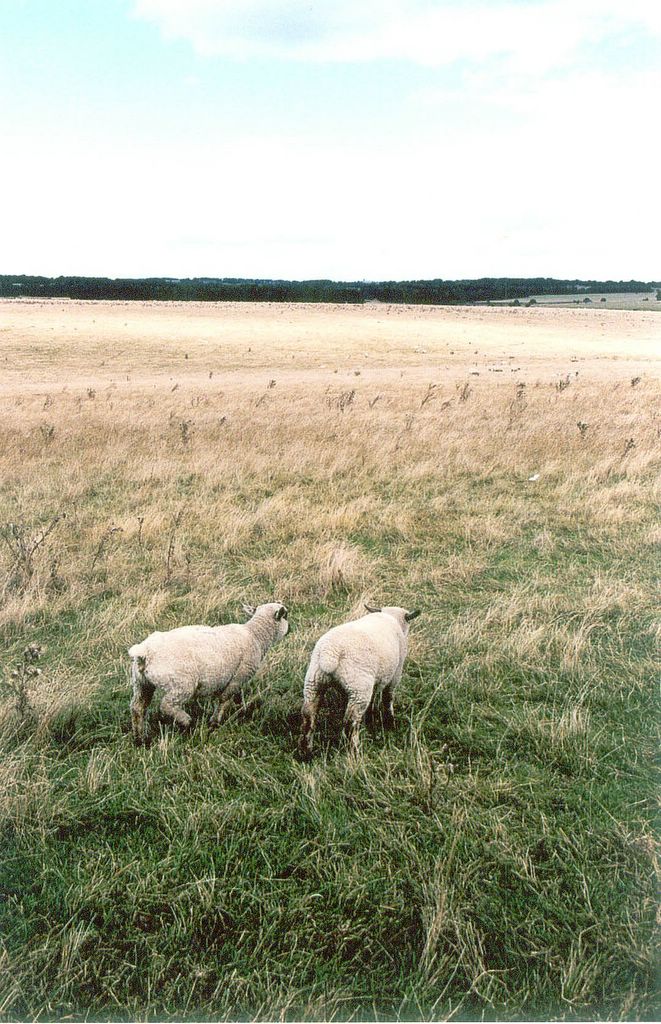
Snapped this picture very near to the Stonehenge when in UK. The sheep were absolutely still as if in some rapture. Every time I look at this snap I get the feeling, like below.

We are:
Like excited mice nibbling tunnels through a cheese block
Like short-sighted frogs in a dark well
Like sail less boats drifting in expanse of the ocean
Like blind earthworms processing mud in earth
Like characters in a computer game

Like we have any clue
Like we know it all
Like we have seen it all
Like we see any end in sight
Like we have any control!

We are…

More like goldfish in an aquarium. We know a wee bit of the environment we are subjected to but neither has any control over it nor any clue of what’s beyond it!

15 May 2005

Orangensaft Zing

K7 is a bundle of optimism and an epitome of positivity.

People call him the Happy-go-Lucky guy. And it’s a joy for people to just be around him. Getting to meet him is exciting and chatting with him is fun. Even a phone call from him cheers you up. He is bubbly, always merry, is optimistic in all that he undertakes, surprises everyone with his ‘bindas’ attitude and exudes his youth energy into all around him.

Highlighting some of the important observations on K7:
  • He believes he is the LUCKIEST guy on earth,
  • ONLY good happens to him,
  • Bad circumstances are temporary and TURN GOOD for him ultimately,
  • His decisions are ALWAYS RIGHT, and
  • Anything’s POSSIBLE with him
It can be noticed that Lady Luck is always inclined to offer her blessings to K7. K7's attitude reinforces his luck base and for this reason persons with such personalities become even more successful.
 
Some behavioral scientists relate this ‘angelic’ effect of K7 is maybe due to his cheerful face. The psychologist Richard Wiseman has explained how being positive and cheerful has direct proportionality on luck. So for the unfortunate few of us who are depressive and negative by nature, our salvation (or success) in this life may depend on point in time when we learn to acquire this K7 personality.
 
Sometimes, many born with small amounts of K7-ism lose it when life turns into a bumpy road after it had been a long smooth superhighway. I think we should never lose our hope and our optimism…ever. We just cannot afford the loss. The difficult period is meant only to test the personality’s elasticity.

Being optimistic is the ONLY way forward.


4 April 2005

C♂ncept of C♀nsorts

Thank you Dan Brown for sweeping the path for me :-)

There exist many entities in this big universal soup. But most of these entities exist as the complements. There can be in the 1-to-1 association; 1-to-many and sometimes even many-to-many. The tendency of each of the complements is to search, reach and assist in the completion of the whole. Until then there is yearning and incompleteness.

 The Siva-Shakti form fascinates me. The familiar Ardhanareshwara form is a good (visual) representation of this Siva-Shakti union. It is the form that shows one half as Shiva, the male principle, and other half as Parvati, the female principle. Each half in the divided states supports, inspires, tickles, irritates, complements and supplements the other in a sort of playfulness. The union brings the bliss and stillness in a sort of everlasting orgasm. In Hinduism, the concept is easily acceptable by any common man because of the way Hinduism loads and codes the answers to the riddles of universe with deities, symbolism and myths.


In Hinduism most (if not all) of gods in the pantheon have one or more (1-to-many) ‘consorts’ (Note: They were not wives but 'consorts'. Marriages are for the society and unnatural :-) ) In the polytheistic pantheon gods-goddesses combinations existed across cultures like with the Egyptians (Isis-Osiris), Greek (Adonis-Aphrodite) and more. The many-to-many structures seems to be prevalent in some old rare uncategorized societies like tribes, new-age pagan revivals etc

Completion is the way forward.

29 March 2005

Singularity


The Yin-Yang: It looks like two distinct forces or entities trying to dominate each other as well as try become/consume the other at the same time. Each is in continuous action in doing so. But either of the two would have no objective or movement without the other. Call the two forces/entities whatever you like: White & Black; Passive & Active; Light & Dark; Good & Evil.


The Yin and the Yang are enclosed or rather confined into ONE circle. The ONE can be regarded as Singularity (Adwaitha Vedanta) while the Yin-Yang forms represent Duality (Dwaitham). The two are inherent of the ONE and ONE manifests into the two. And this is the simplest representation of the relationship between duality and singularity.

 
Extending the above concept a little further: In the beginning there is nothing else but the ONE; after all ONE is everything. Then ONE stopped being and within itself two things manifested. The action between these two in turn churned out the rest of the complexities. So in my understanding: all intricacies, harmonies, clashes, causes and effects that we can imagine arise from and exist within the ONE big system.

 
I would call this ONE the Universe as a whole. Some prefer to call the bigger system the Universal spirit or Universal consciousness or God. Most religious books also corroborate this concept.

 
The question is why did ONE complicate itself by dividing into two by its own intent? Probably just for entertainment ;-)